

Hello everyone,
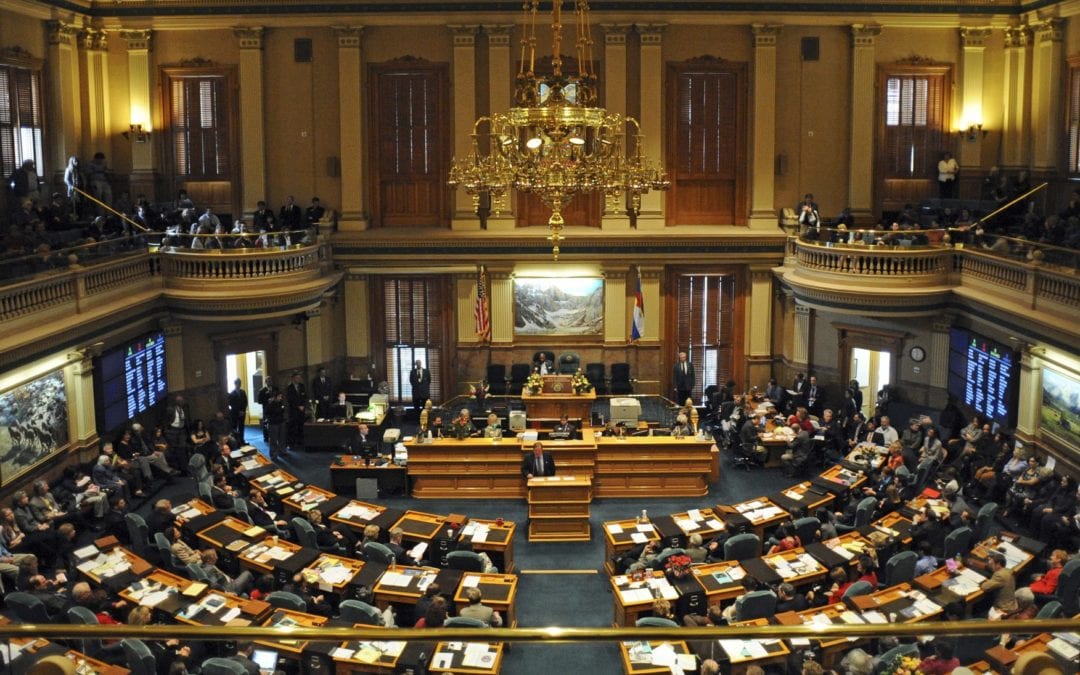
The state capitol, normally a quiet pace this time of year, has been busy recently. There has been a lot going on so please forgive the extra-long update.
Last Tuesday, the legislature completed a six-day extraordinary session (also called a special session). Governor Polis called the legislature back to address a revenue shortfall. Democrats argued that the shortfall was the result of H.R. 1 at the federal level. Republicans countered that Democrats overspending caused the shortfall and that Colorado could have weathered the reduced revenue if Democrats had heeded Republicans’ warnings over the last few years that Colorado could not afford all the spending.
The federal tax cuts in H.R.1 impacted Colorado’s revenues because Colorado closely mirrors the U.S. Tax Code in calculating state income tax. This is why our state income tax return is relatively simple. As a result, when the feds cut taxes at the federal level, it cut taxes at the state level. The tax cuts in H.R. 1 resulted in Colorado collecting approximately $1.2 billion less in state income taxes. This caused Governor Polis to call the legislature back on August 21st to address the shortfall. Because there was TABOR surplus at the time, the budget shortfall ended up being approximately $780 million. Since the Governor believed the legislature needed to come back to address the shortfall, he also added fixing an artificial intelligence (AI) bill passed in 2024, some health care issues, including state funding for Planned Parenthood, and funding for school meals to the call. During a special session, the governor’s call dictates what legislation the General Assembly can pass.
There were 30 bills introduced during the special session, but by the end of the first day, it was clear that only 11 or 12 could pass. The bills that impacted the budget moved quickly through the process because Democrats, who control the legislature, were all on the same page on how to address the shortfall. These bills increased revenues by eliminating tax credits for businesses and business owners, selling tax credits, tighter controls on “tax havens,” and eliminating the state’s vendor fee that allowed retailers to keep a portion of the state sales taxes they collect to offset their administrative costs in collecting and remitting the tax. These bills are anticipated to increase revenues by approximately $245 million addressing a little less than a third of the revenue shortfall. The legislature left how to address the balance of the shortfall to the governor.
There was a lot of sitting around during the special session due to closed-door negotiations on how to “fix” SB 24-205 Consumer Protections for Artificial Intelligence. SB 24-205 was a first in the nation attempt to establish standards and requirements for those who develop and deploy AI. AI deployers include not only big business, but small business, hospitals, schools, colleges, and governments. Both developers and deployers were concerned about the costs of complying with SB 24-205. Back in 2024 when Governor Polis signed SB 24-205, he issued a signing statement indicating that he had strong reservations about the bill’s complex regulations and was worried it would tamper innovation. He asked the legislature to improve the bill before it went into effect on February 1, 2026. An attempt to change the bill during the regular 2025 legislative session failed.
During the special session, four bills were introduced to “fix” SB 24-205 – two from Republicans and two from Democrats. On day one the Republican bills were killed. The “main” AI bill was sponsored by Senate Majority Leader Robert Rodriguez (D-Denver) (also the sponsor of SB 24-205). The other bill was sponsored by Rep. William Lindstedt (D-Broomfield) and was seen as a potential placeholder in the event the Rodriguez bill died. The CSPA monitored both bills because some of the Patrol’s service providers were concerned about them. Negotiations on the Rodriguez bill took up much of the special session and on Sunday night there was a rumored deal. However, it turned out there was no deal and on Monday Majority Leader Rodriguez announced he would be amending his bill to push out the effective date of SB 24-205 from February 1st to June 30, 2026, giving the legislature time to adopt changes during the 2026 session.
The special session was not without drama or interpersonal conflict. On Thursday, the first day of the special session, House Democrats announced they intended to censure Rep. Ryan Armagost (R-Berthoud) for taking a picture of Rep. Yara Zokaie (D-Fort Collins) in a short dress, blazer and knee-high boots during debate on the House floor last session. Rep. Armagost shared the photo in a private group chat with House Republicans some of whom compared Rep. Zokaie’s outfit to that of a stripper or prostitute. The photo was later posted online by an anonymous social media account and Rep. Zokaie indicated it resulted in threats directed at her and her young children. Back in June, Rep. Armagost announced he would be stepping down September 1st to move to Arizona for a job. He had been excused from the special session and was not present, but when news of the censure broke, he resigned from the House effective immediately. With Rep. Armagost no longer in the House, House Democrats could not censure him. However, on Tuesday, the final day of the special session, they brought a resolution condemning his actions. It was during debate on the resolution that tensions escalated.
During the debate, Rep. Zokaie accused House Minority Leader Rose Pugliese (R-Colorado Springs) of misleading her about who took the picture soon after the picture was taken. Minority Leader Pugliese said that she told House Majority Leader Monica Duran (D-Wheat Ridge) that Rep. Armagost had taken the picture. Minority Leader Pugliese indicated she was sorry for both what had happened to Rep. Zokaie and that Democratic leadership had chosen not to tell Rep. Zokaie that Rep. Armagost had taken the picture. Majority Leader Duran then went to the mike to chastise the Minority Leader. The working relationship between the Majority Leader and Minority Leader is critical in how the House functions. It looks like that relationship is now fractured and that does not bode well for next session.
Getting back to the budget shortfall. Last Thursday, after the special session ended, the Governor announced how he intended to address the remaining portion of the shortfall. He plans to transfer $147 million from various funds to the General Fund, spend down the statutory reserve from 15% to 13% generating up to $329 million, and making approximately $105 million in budget cuts. The budget cuts include eliminating a 1.6% rate increase for Medicaid health care providers, reducing higher education funding by $12 million, reducing grants by $2 million, and approximately $3 million in savings from a hiring freeze that is in effect until the end of the year. Therefore, as it turns out, only about $105 million of the $780 million shortfall was addressed though budget cuts. This means next year’s budget is going to be another tough one.
If you have made it this far, thanks for sticking with me through this long update. Only about 18 weeks until the start of the 2026 legislative session.
Bill Skewes
Lobbyist